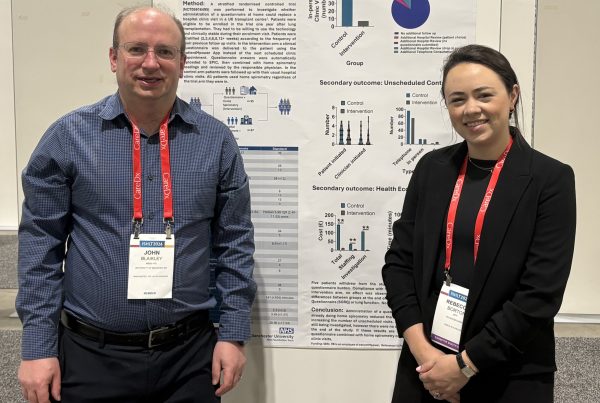
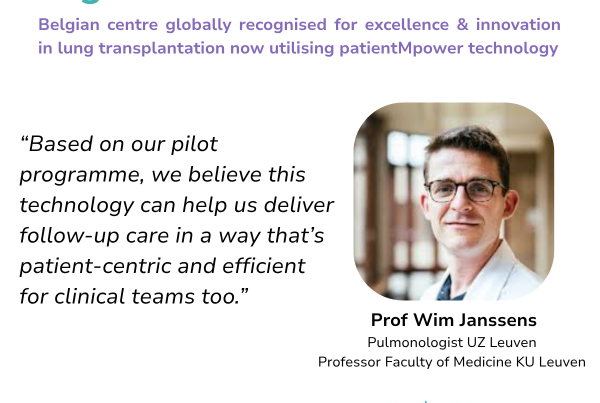
In the second instalment of our 2025 Highlights Series we look back to September, and the European Respiratory Society Congress in Amsterdam. ERS is an annual event on our calendar, but 2025’s particular congress was particularly special as this saw the largest number of posters utilising patientMpower technology presented at any one conference. Nine posters, from collaborations & independent research conducted across Europe & the US, were presented. As well as providing further evidence in COPD and Lung Transplant the posters presented also provided data in novel indications and use cases, including SARD-ILD, LAM and remote oxygen titration. Here’s a quick overview of some of the evidence presented in those novel areas at ERS 2025.
Monitoring of Systemic Autoimmune Rheumatic Disease Interstitial Lung Disease (SARD-ILD)
Clinicians from Royal Wolverhampton NHS Trust, UK reported on the use of patientMpower technology for remote monitoring of SARD-ILD. Ten patients were recruited to home spirometry (mean age 56.4 years), for a mean duration of 15 weeks (range 4-22). Adherence was good with parameters reported for 77% of enrolled weeks. The results were reviewed fortnightly by ILD team. Two patients had worsening symptoms with a drop in FVC (>10%), resulting in further evaluation with thoracic imaging and ILD MDT discussion. Patients who completed feedback (n=5, 50%) reported feeling confident with managing their ILD using this platform after being enrolled in this program. It was concluded remote monitoring in SARD-ILD can identify progression earlier than relying on traditional hospital based pulmonary function tests, and that it has potential to empower patients so they feel they have better control over their illness.
Remote Monitoring to Support Clinical Decision-Making in Long-Term Oxygen Therapy titration (LTOT) in COPD
Clinicians from Beaumont Hospital, Ireland reported on a novel programme utilising patientMpower technology to enable remote titration of long-term oxygen therapy. This approach can reduce the need out-patient based titration of LTOT, which may not always reflect patients’ actual oxygen needs and can introduce additional care burden. Twenty-two patients were recruited, with participants using patientMpower technology to remotely monitor oxygen saturations (SpO2) 4 times daily over 2-3 weeks. Weekly mean SpO2 was calculated to guide oxygen titration decisions. Data demonstrated that the approach enabled successful oxygen titration without the need for clinic-attendance. There was 100% agreement between virtual decision making & a subsequent in-clinic validation check.
- 23% patients were successfully weaned off oxygen
- 68% had appropriate oxygen prescription confirmed
- 9% patients were identified as hypoventilated, and successfully up-titrated on O2
The evaluation concluded that remote monitoring technology is a safe and valuable addition to support LTOT titration in COPD patients. It offers a cost-effective, scalable solution to enhance long-term management and reduce healthcare use.
Mobile app-based home spirometry in Lymphangioleiomyomatosis
Lymphangioleiomyomatosis (LAM) is a rare, progressive lung disease predominantly affecting women of reproductive age. This study, conducted in conjunction with the LAMFit pilot study, a remote exercise program developed by Dr. Mary Beth Brown and Claire E. Child at the University of Washington, US, aimed to assess the feasibility of integrating home spirometry into the care of LAM patients.
Digital home spirometry (patientMpower) was deployed in 25 women with LAM (age 52.7±13 years) participating in the 28-week LAMFit digital fitness program. Home spirometry was included in the remote assessments performed at weeks 2, 14, and 27 with patients receiving automated feedback on spirometry quality according to 2019 ATS/ERS criteria via integrated ArtiQ.QC software. Eighty-eight percent of participants successfully used the app for home spirometry, with protocol adherence of 66%. The data consistently demonstrated high quality, with 97.42% of sessions yielding usable or acceptable FEV1 measurements.
The study indicates that remote spirometry is a feasible and effective method for monitoring patients with LAM, and the impact of home spirometry on patient care delivery warrants further study.