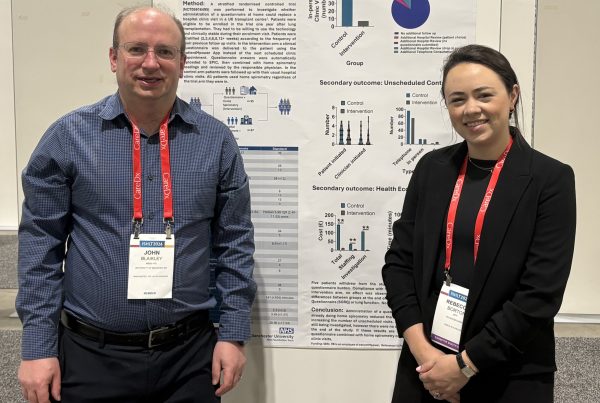
In this instalment of our 2025 Highlights Series we look back to November, and presentation of the preliminary findings from REMOTE-ILD randomised controlled trial at the British Thoracic Society Winter Meeting.
REMOTE-ILD is a multicentre, 12-month randomised controlled trial (RCT) assess the clinical and cost-effectiveness of remote monitoring of spirometry and pulse oximetry in patients with interstitial lung disease (ILD). The trial was led by Imperial College Healthcare NHS Trust, with Respiratory Consultant Dr Melissa Wickremasinghe as Principal Investigator, in collaboration with Action for Pulmonary Fibrosis, patientMpower, University College London, Imperial College and the National Heart & Lung Institute. The study was funded by the National Institute for Health and Care Research (NIHR).
Randomised controlled trials, considered to be the gold standard of clinical evidence, remain a rarity in digital health. The presentation of the positive findings from REMOTE-ILD was therefore a key highlight of 2025. Here’s a summary of the study data shared at BTS.
REMOTE-ILD: Preliminary Results Presented at British Thoracic Society Winter Meeting 2025
- Multicentre 12-month RCT in 139 participants shows the use of remote monitoring can support clinical decision-making in the care of patients with interstitial lung disease (ILD)
- Remote monitoring increased availability of contemporaneous lung function data at patients’ clinic review to 92% vs. 28% in usual care group (p<0.001)
- Remote monitoring identified changes in clinical parameters between pre-scheduled visits in 8.3% of patients, resulting in additional medicine initiation (3.3%) and oxygen assessment (5%)
Interstitial Lung Disease (ILD) is a group of around 200 complex lung conditions. Most are progressive, but the rate of decline varies considerably between patients, meaning individualised care and frequent patient follow-up is essential. Access to recent lung function test (LFT) results at the time of the review is fundamental to appropriate clinical decision making. However, due to various factors – from capacity challenges to the sheer burden of clinic-based assessments in this patient group – recent results are often unavailable at follow-up.
Preliminary results from the REMOTE-ILD randomised controlled clinical trial, presented in London at the 2025 British Thoracic Society Winter Meeting by Dr Sarah Barth of Imperial College NHS Trust, shows remote monitoring significantly increased the availability of recent LFTs at the time of patient review versus standard care alone – from 28% (in usual care patients) to 92% of visits (p<0.001) – supporting appropriate and timely clinical decision-making for optimised patient care. Furthermore, remote monitoring enabled early interventions including new medication initiation and oxygen assessment in 8.3% of patients, through the rapid identification of changes in care needs between patients’ scheduled visits.
Adherence to weekly spirometry across the 12 months remained very high, at a median of 80.8%.The mean percentage of spirometry readings per person which were acceptable according to ATS/ERS criteria was 74.46%, and there was high correlation between home and hospital FVC readings.
The trial demonstrated use of home spirometry led to a greater number of scheduled clinical appointments with contemporaneous lung function when compared with usual care. Availability of this data supported clinical decision making, whilst remote monitoring supported responsive clinical management.
The robust methodology of REMOTE-ILD gives these findings particular importance, and significantly strengthens the ever-growing evidence base for the use of remote monitoring in ILD, supporting wider adoption in routine clinical practice. Full publication of the findings from REMOTE-ILD is expected in 2026.