Welcome to Our Highlights of 2025 Series!
Celebrating patientMpower’s Tenth Year at the Forefront of Digital Health Innovation
2025 saw patientMpower celebrate our tenth year in business, and what an amazing year it was for us. We saw the publication of two important randomised controlled trials utilising patientMpower technology, announced the development of our AI solution to predict lung disease progression, launched new workflow automation feature to support clinician efficiency, signed deals with some major new customers, and released new evidence at a number of international congresses.
Change in Digital Health is high pace, and the growing application of AI in the health sector will only accelerate this in the months and years to come. As a innovation-focused Company we typically spend more time looking to the future, but over the course of the next few posts we want to look back at some of the highlights of our tenth anniversary year. We start with something that remains relatively rare in digital health; the publication of a randomised controlled trial. RCTs are considered the gold standard of evidence in healthcare. The publication in May of an independently conducted RCT provided external validation of the significant improvements in health outcomes & reductions in resource use achieved through patientMpower-enabled self-management of COPD. Here’s a summary of the trial and it’s findings, definitely a 2025 highlight!
RCT Demonstrates Digitally- Enabled Self-Management of COPD Reduced Hospitalisations by 82%
Impressive outcomes for digitally-enabled self-management of COPD have been demonstrated in independent randomised controlled trial research published by Lisa Glynn & colleagues in JMIR mHealth & uHealth.
The trial, conducted at Dublin’s Tallaght University Hospital, randomised 92 patients with COPD to receive a self-management program delivered via patientMpower’s smartphone-based digital health application, with or without nursing telephone support, versus standard out-patient based care alone for 12 months.
The trial demonstrated that compared to standard out-patient based care alone patientMpower-enabled self-management of COPD significantly improved health outcomes and reduced healthcare utilisation:
- 82% reduction in exacerbation-related hospitalisation (p=0.02)
- 80% reduction in exacerbation-related GP presentations (p =0.005)
- 50% increase in exercise capacity (p=0.02)
- 27% decrease in severe breathlessness (95%CI = 0.12-0.58)
No further benefit was observed with the addition of nursing telephone-based support versus patientMpower enabled self-management alone.
Whilst the principles of self-management are central to COPD patient care, the effectiveness of traditional self-management programs are often limited by issues including patient engagement & poor self-recognition of exacerbation symptoms. This RCT demonstrates patientMpower’s digital health application can enable highly effective self-management of COPD, addressing challenges observed with traditional self-management supports. 83% of patients using patientMpower self-management technology had “very good” or “excellent” engagement at 12 months, whilst self-monitoring and tailored educational videos supported exacerbation recognition and patient activation.
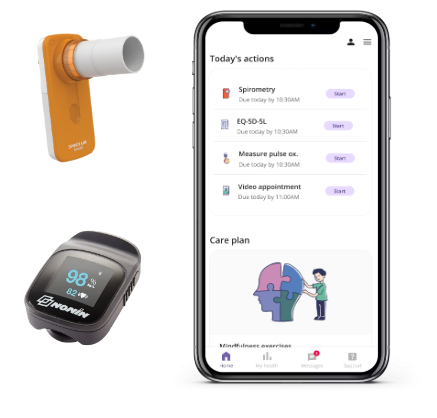
patientMpower’s self-management solution connects with clinical grade monitoring devices & provides tailored educational content
As well as significant impacts on patient outcomes, COPD is associated considerable healthcare burden. COPD exacerbations are a leading cause of hospitalisation internationally, with COPD accounting for for 56% of the overall respiratory care costs in the EU. Whilst this trial did not specifically examine health economic outcomes, the magnitude of the observed reduction in hospitalisation compared to relatively small costs of digitally-enabled self-management suggest that this approach is highly cost-effective.
The study indicates that when people living with COPD are provided with the right tools they can, and will, effectively manage their own condition. That’s good news for patients, and it’s good news for healthcare systems too.